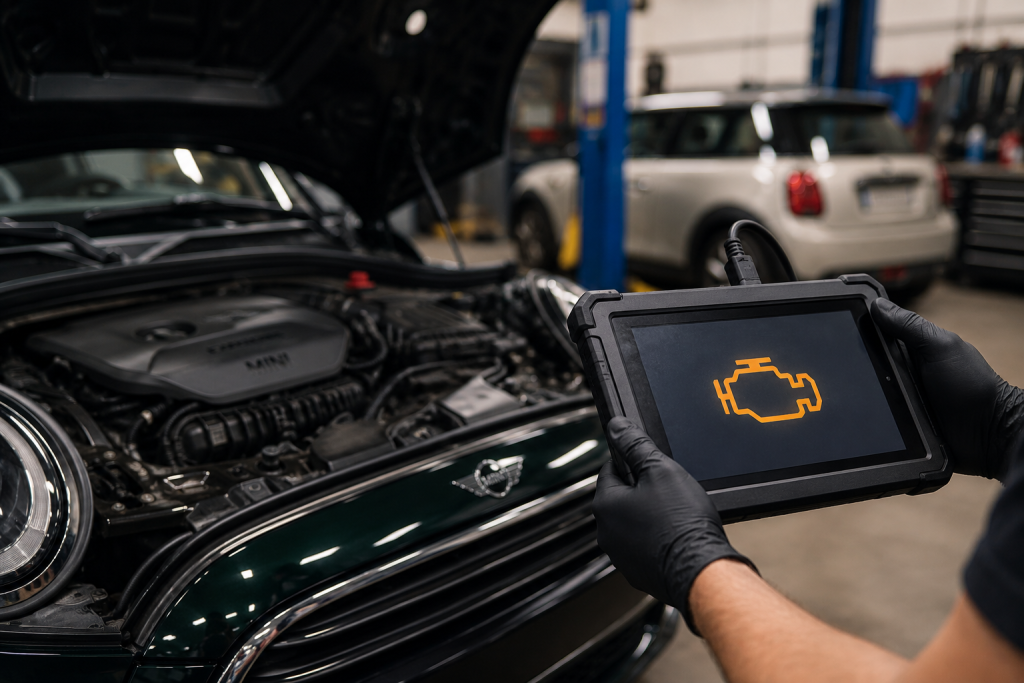
At AutoTechnic, MINI diagnostics are a significant part of what we do every day. As an enthusiast-owned German automotive repair shop in Mooresville, NC, our team specializes in BMW, MINI, and Mercedes-Benz vehicles, bringing more than 30 years of combined experience to every inspection and repair. Over the years, we’ve diagnosed countless check engine light concerns for MINI owners throughout Mooresville, Lake Norman, Davidson, Cornelius, Huntersville, Denver, Troutman, and the surrounding communities. From older R56 Cooper S models to newer F56 Cooper S and F60 Countryman vehicles, we’ve seen firsthand how warning lights can affect drivers across the greater Lake Norman area.
One of the most common questions we hear from MINI owners is whether a check engine light means something serious. The answer depends entirely on the underlying cause. While some warning lights indicate issues that require immediate attention, others may be related to developing problems that can be addressed before they become major repairs.
In our experience, many MINI owners throughout Mooresville and the Lake Norman region assume the worst when the check engine light appears. However, the warning light itself is simply an indication that the vehicle’s onboard systems have detected a fault. Proper diagnostic testing is the only reliable way to determine what triggered the warning and what steps should be taken next.
Understanding the most common causes behind a MINI check engine light can help owners make informed decisions about maintenance, repairs, and vehicle reliability.
The Most Common Reasons a MINI Check Engine Light Comes On
Modern MINI vehicles rely on dozens of sensors and control modules to monitor engine performance, fuel delivery, emissions systems, ignition timing, and overall drivability. When one of these systems detects a problem, the check engine light is triggered.
Ignition coil failures are among the most common issues we diagnose for MINI owners in Mooresville and surrounding Lake Norman communities. As ignition coils begin to weaken, they can cause engine misfires, rough idling, hesitation during acceleration, and reduced fuel economy. On turbocharged MINI models equipped with B46 and B48 engines, ignition system issues often appear before drivers notice significant performance changes.
Spark plugs are another frequent culprit. Many MINI owners are surprised to learn that worn spark plugs can place additional strain on ignition coils and contribute to recurring misfire codes. Replacing spark plugs at the appropriate intervals helps maintain proper combustion and supports long-term engine reliability.
Oxygen sensors also play a significant role in check engine light activation. These sensors monitor exhaust gases and help the engine management system maintain the correct air-fuel mixture. As sensors age, inaccurate readings can trigger warning lights and negatively affect fuel economy and performance.
Thermostat and cooling system faults are another pattern we frequently see in our Mooresville repair facility. Many owners do not immediately associate cooling system concerns with a check engine light, but modern MINI vehicles continuously monitor engine operating temperatures. When temperatures fall outside acceptable ranges, fault codes can be stored even before obvious symptoms appear.
Why MINI Diagnostic Testing Matters
A common mistake we see is replacing parts before the vehicle has been properly diagnosed. While online forums and generic code readers may point owners toward possible causes, they rarely provide enough information to accurately identify the root problem.
For example, a fault code indicating a misfire does not necessarily mean the ignition coil has failed. The issue could stem from a spark plug, fuel injector, vacuum leak, carbon buildup, or several other factors. Replacing parts based on assumptions often results in wasted time and unnecessary expense.
Professional MINI electrical diagnostics allow technicians to analyze fault codes, review live vehicle data, examine system performance, and identify the actual cause of the warning light. This process is especially important on modern MINI vehicles, where multiple systems interact with one another and seemingly unrelated issues can produce similar fault codes.
In our experience serving MINI owners throughout Mooresville, Davidson, Cornelius, and Huntersville, accurate diagnostics often save vehicle owners money because the repair process begins with verified information rather than guesswork. Proper testing also helps identify developing problems before they become larger and more expensive repairs.
Many MINI owners are surprised to learn that the same fault code can have multiple causes. This is why experienced technicians rely on diagnostic procedures, system testing, and real-world repair experience instead of simply replacing the component referenced by a fault code.
Common MINI Models and Their Typical Check Engine Light Issues
While every MINI model has its own maintenance requirements and repair history, certain patterns emerge across specific generations.
The F56 MINI Cooper S frequently experiences issues related to ignition components, thermostat assemblies, evaporative emissions systems, and oxygen sensors. These problems often trigger warning lights before noticeable drivability concerns develop.
Owners of older R56 MINI Cooper S models equipped with the N14 engine may encounter timing chain concerns, carbon buildup, high-pressure fuel pump issues, and turbocharger-related faults. Many of these problems can initially present as a check engine light accompanied by minor performance symptoms.
F60 Countryman owners commonly experience warning lights related to emissions components, fuel system monitoring, and electronic control systems. As these vehicles accumulate mileage, preventative maintenance becomes increasingly important for avoiding unexpected warning lights and performance issues.
One pattern we commonly see among MINI owners throughout the Lake Norman area is that warning lights often appear after maintenance has been postponed. While some failures are unavoidable, many check engine light concerns can be reduced through consistent inspections and proactive service.
Can You Continue Driving With a MINI Check Engine Light On?
The answer depends on how the warning light is behaving and whether additional symptoms are present.
If the check engine light is illuminated but remains steady, the vehicle may still be safe to drive for a short period while arrangements are made for diagnostic testing. However, this does not mean the issue should be ignored. Continuing to drive without understanding the cause can allow minor problems to become major repairs.
If the check engine light is flashing, immediate attention is required. A flashing warning light often indicates an active misfire capable of damaging the catalytic converter. In these situations, continued operation can significantly increase repair costs.
A common misconception is that if the vehicle feels normal, the problem must be minor. Modern MINI vehicles can store fault codes long before noticeable drivability symptoms develop. Early diagnosis often provides an opportunity to address concerns before additional components are affected.
When warning lights appear alongside rough idling, reduced power, unusual noises, overheating concerns, or poor fuel economy, professional evaluation should be scheduled as soon as possible. For drivers commuting between Mooresville, Huntersville, and Charlotte, addressing these concerns early can help prevent unexpected breakdowns and costly repairs.
How Proper Maintenance Helps Prevent Warning Lights
While no maintenance strategy can eliminate every potential repair, preventative service remains one of the most effective ways to reduce unexpected warning lights.
Regular inspections help identify worn ignition components, developing oil leaks, cooling system weaknesses, and electronic faults before they trigger dashboard warnings. Many MINI owners focus exclusively on oil changes while overlooking systems that commonly contribute to warning lights and drivability issues.
One issue that often goes unnoticed is the impact of deferred maintenance on engine performance. Worn spark plugs, aging ignition coils, contaminated sensors, and neglected cooling system components may continue functioning for a period of time before ultimately triggering fault codes.
Professional MINI repair services that include routine inspections can help identify these concerns early. This approach not only reduces the likelihood of unexpected warning lights but also supports long-term reliability and ownership satisfaction.
As German vehicle specialists serving Mooresville and the greater Lake Norman area, we frequently find that preventative maintenance costs significantly less than repairing damage caused by delayed service.
Why Did My MINI Check Engine Light Come On?
A MINI check engine light can be triggered by numerous issues, including ignition coil failures, worn spark plugs, oxygen sensor faults, thermostat problems, fuel system concerns, emissions-related issues, or electronic system malfunctions. The specific cause can only be confirmed through professional diagnostic testing. Because many of these issues produce similar symptoms, MINI owners in Mooresville and surrounding areas benefit from having the vehicle inspected by technicians familiar with common MINI failure patterns.
Can I Drive My MINI With the Check Engine Light On?
If the light remains steady and the vehicle operates normally, you may be able to drive for a short period while scheduling service. However, a flashing check engine light indicates a potentially serious problem that should be addressed immediately to prevent additional damage. If you’re driving throughout the Lake Norman area and notice a flashing warning light, it’s best to limit vehicle operation until the issue can be diagnosed.
Does a Check Engine Light Always Mean an Expensive Repair?
No. Some warning lights are caused by relatively minor issues, while others indicate more significant concerns. Professional diagnosis is essential because the severity of the repair cannot be determined based solely on the presence of the warning light. In many cases, early diagnosis helps MINI owners avoid larger repair bills later.
How Long Does MINI Diagnostic Testing Take?
Diagnostic testing times vary depending on the complexity of the issue. Simple concerns may be identified quickly, while intermittent faults or multiple system issues can require additional testing to accurately determine the root cause. The goal is not simply to read fault codes but to verify exactly why those codes were triggered.
Where Can I Get My MINI Diagnosed in Mooresville, NC?
MINI owners throughout Mooresville, Lake Norman, Davidson, Cornelius, Huntersville, Denver, and Troutman benefit from working with technicians who specialize in German vehicles and understand the unique systems found in modern MINI models. While online resources can provide general information, professional diagnostic testing remains the most effective way to identify the cause of a warning light and prevent unnecessary repairs.
Schedule Professional MINI Diagnostics in Mooresville
If your MINI’s check engine light has come on, the most important step is obtaining an accurate diagnosis before replacing parts or making assumptions about the problem. Modern MINI vehicles are highly sophisticated, and many warning lights can have multiple potential causes that require professional testing to identify correctly.
At AutoTechnic, we specialize in diagnosing and repairing MINI vehicles using manufacturer-level diagnostic procedures and years of hands-on experience working with common MINI issues. Whether you’re dealing with a persistent check engine light, drivability concerns, or simply want peace of mind about your vehicle’s condition, our team can help determine the root cause and recommend the appropriate repair.
Conveniently located in Mooresville, NC, our shop proudly serves MINI owners from across the Lake Norman region, including Davidson, Cornelius, Huntersville, Denver, Troutman, Statesville, and nearby communities. Many of our customers choose us because they want a dedicated German vehicle specialist close to home rather than traveling to Charlotte for MINI service and diagnostics.
To schedule a diagnostic appointment, contact AutoTechnic today or call us at (704) 696-8019.