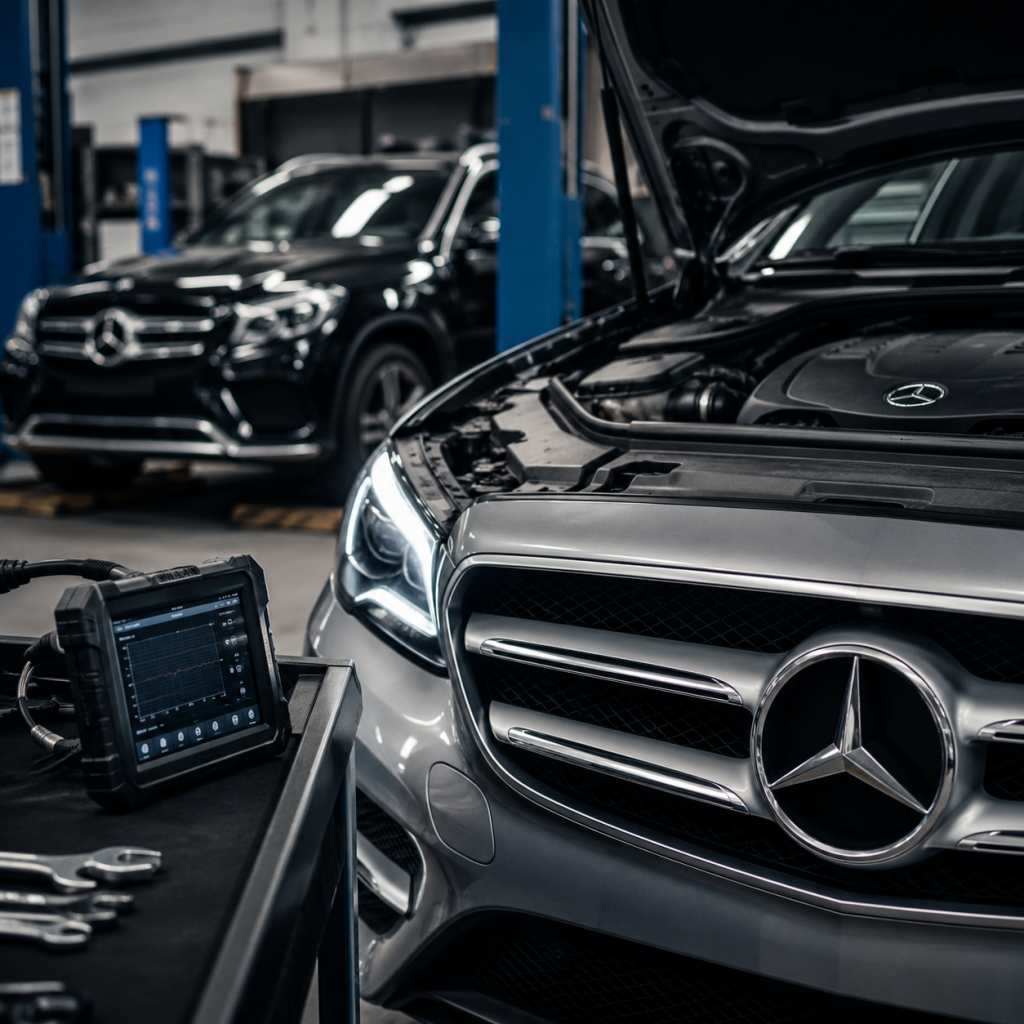
Mercedes-Benz vehicles are engineered with advanced electronics, turbocharged drivetrains, and highly sophisticated engine management systems designed to deliver smooth performance and refined drivability. While these systems improve efficiency and responsiveness, they also make accurate diagnostics far more important when warning lights appear.
At AutoTechnic in Mooresville, NC, we specialize in Mercedes-Benz, BMW, and MINI diagnostics and repair for drivers throughout the Lake Norman area. Our enthusiast-owned shop regularly diagnoses check engine light concerns on Mercedes GLE and C-Class models involving ignition systems, electrical faults, turbocharger performance issues, and emissions-related problems.
Many owners assume a check engine light automatically means a failed sensor or simple repair. In reality, modern Mercedes-Benz systems are significantly more complex. Mercedes owners are often caught off guard because the vehicle may still appear to drive normally during the early stages of a problem. In many cases, the first signs are subtle, including slightly rough startup behavior, delayed acceleration, or intermittent dashboard warnings that are easy to ignore initially. Proper diagnostics often involve evaluating live engine data, airflow calculations, voltage behavior, and communication between multiple onboard modules before accurate repairs can be recommended.
With more than 30 years of combined experience, our team focuses on dealership-level diagnostics, transparent recommendations, and long-term reliability using high-quality components from trusted suppliers like Liqui Moly and WorldPAC.
Ignition System Problems and Engine Misfires
Ignition-related faults are one of the most common reasons Mercedes GLE and C-Class models trigger a check engine light. Turbocharged Mercedes engines rely on precise combustion timing, meaning even minor ignition irregularities can quickly affect drivability.
Drivers often notice rough idle conditions, hesitation during acceleration, vibration at startup, or reduced fuel economy before the warning light appears. In more severe cases, the check engine light may flash, indicating an active misfire condition capable of damaging catalytic converters.
Although ignition coils and spark plugs are common failure points, professional diagnostics frequently uncover additional contributing factors such as carbon buildup, injector imbalance, vacuum leaks, or airflow irregularities.
Many repair facilities replace components based solely on stored codes, but Mercedes-Benz systems often require deeper analysis to identify the actual root cause. At AutoTechnic, our technicians regularly perform advanced Mercedes repair in Mooresville for vehicles experiencing intermittent misfires, rough cold starts, or unexplained power loss.
Early diagnosis is important because unresolved misfires can eventually lead to catalyst damage, excessive fuel contamination, and larger drivability concerns.
Mercedes Electrical and Voltage-Related Warning Lights
Modern Mercedes-Benz vehicles contain dozens of interconnected control modules that communicate constantly through complex electronic networks. Because these systems are highly sensitive to voltage fluctuations, even relatively small electrical irregularities can trigger multiple warning lights or unpredictable vehicle behavior.
Owners frequently begin researching electrical issues after noticing intermittent dashboard messages, random warning indicators, reduced performance mode activation, or occasional no-start conditions. One pattern our technicians regularly see on newer Mercedes models involves low startup voltage creating communication interruptions between drivetrain and stability modules, triggering multiple warning lights simultaneously even though the underlying issue may simply be battery-related.
In many situations, the underlying problem involves weak batteries, charging system inconsistencies, poor grounding connections, or communication faults between modules.
One of the challenges with Mercedes electrical diagnostics is that the symptoms often appear unrelated. A low-voltage condition can create warning lights involving the transmission, steering system, stability control, or drivetrain communication systems simultaneously.
At AutoTechnic, we frequently perform detailed Mercedes electrical diagnostics for drivers experiencing intermittent warning lights or communication-related faults. Proper testing includes evaluating charging system behavior, monitoring voltage stability, and analyzing module communication.
Generic scan tools frequently miss Mercedes-specific communication issues, which is why many owners end up replacing batteries or sensors without resolving the actual problem.
Turbocharger and Airflow System Faults
Turbocharged engines provide the responsive performance Mercedes owners expect, but they also introduce additional diagnostic complexity when warning lights appear.
Many Mercedes GLE and C-Class owners experience sluggish acceleration, delayed throttle response, drivetrain malfunction warnings, or reduced power before realizing the issue may involve airflow or boost regulation problems.
In many cases, the turbocharger itself is not actually the failed component.
At AutoTechnic, we regularly inspect systems involving boost pressure leaks, charge pipe failures, wastegate irregularities, airflow restrictions, and turbo control faults. Modern Mercedes engines rely heavily on precise airflow calculations, meaning even small pressure leaks can disrupt fuel trim readings and trigger warning lights.
Drivers throughout Mooresville and Lake Norman often notice these concerns gradually. We commonly see higher-mileage GLE and C-Class models begin developing subtle acceleration inconsistencies long before the vehicle enters reduced power mode or triggers major drivetrain warnings.
Professional diagnostics require far more than reading fault codes. Accurate testing involves analyzing airflow data, boost pressure behavior, and overall engine performance under operating conditions.
Emissions System and Fuel Trim Problems
Emissions-related faults have become increasingly common on modern Mercedes-Benz vehicles due to the complexity of today’s direct injection and exhaust monitoring systems.
Some drivers notice the check engine light without any major drivability symptoms, while others experience rough cold starts, reduced fuel economy, delayed throttle response, or inconsistent acceleration.
At AutoTechnic, we regularly diagnose emissions-related concerns involving NOx sensors, oxygen sensors, EVAP system leaks, airflow irregularities, carbon buildup, and fuel trim imbalances.
Modern Mercedes direct injection systems are extremely efficient, but they are also highly sensitive to airflow inconsistencies and combustion irregularities. Over time, carbon deposits can accumulate on intake valves and affect engine performance.
Vehicles used primarily for short trips or stop-and-go driving often experience increased carbon buildup because the engine does not consistently operate at ideal temperatures long enough to reduce deposits effectively.
According to Mercedes-Benz USA, modern emissions systems continuously monitor fuel delivery, exhaust output, and combustion efficiency to maintain proper vehicle performance.
Replacing components based solely on stored fault codes can lead to unnecessary repairs without resolving the actual source of the warning light, which is why accurate diagnostics are critical.
Frequently Asked Questions About Mercedes Check Engine Lights
Why would my Mercedes display a check engine light if it still seems to drive normally?
Modern Mercedes-Benz systems continuously monitor engine performance, emissions output, and electrical communication. Many warning lights appear before noticeable drivability symptoms develop.
Why would my Mercedes display multiple warning lights at the same time?
Yes. Mercedes vehicles are highly sensitive to voltage fluctuations, and weak batteries can create communication faults between multiple control modules, triggering several warning indicators at once.
Is it safe to continue driving with a flashing Mercedes check engine light?
A flashing check engine light often indicates an active misfire condition capable of damaging catalytic converters or other engine components. Professional diagnostics should be performed as soon as possible.
Professional Mercedes Diagnostics in Mooresville, NC
When a check engine light appears on a Mercedes GLE or C-Class model, identifying the root cause accurately is far more important than simply clearing fault codes or replacing parts based on guesswork.
At AutoTechnic, we provide advanced Mercedes diagnostics and repair for drivers throughout Mooresville and the Lake Norman area. Our enthusiast-owned shop specializes in European vehicles and focuses on accurate testing, transparent communication, and long-term reliability.
Whether your Mercedes is experiencing intermittent warning lights, rough performance, reduced power, or electrical communication faults, early diagnostics can often prevent significantly larger repair costs later. Ignoring early warning signs often allows smaller issues to develop into far more expensive repairs, especially on modern European vehicles with interconnected electronic systems.
To schedule professional Mercedes repair and diagnostics in Mooresville, contact AutoTechnic today or call (704) 696-8019 and speak with our team about your vehicle’s warning light concerns.