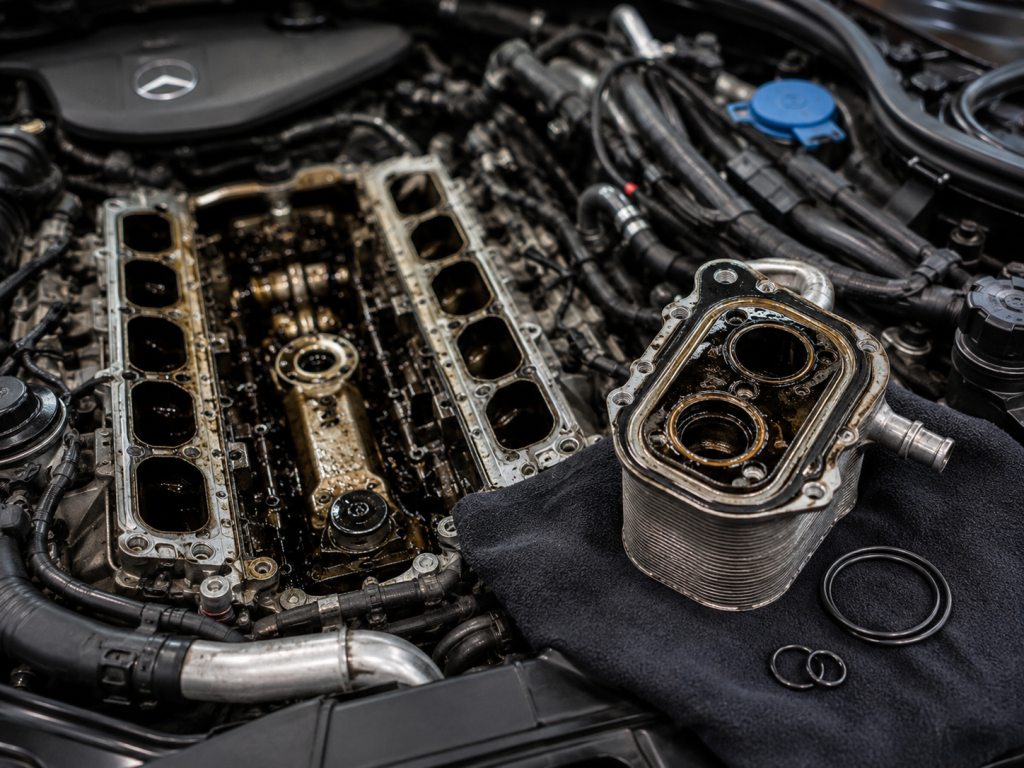
If your Mercedes-Benz diesel smells like hot oil but isn’t leaving a large puddle on the driveway, the leak may be hiding where you can’t easily see it. On vehicles equipped with the Mercedes OM642 3.0L V6 diesel, one well-known source is the oil cooler seal area deep in the valley of the engine beneath the intake system.
For Mercedes owners around Mooresville, Huntersville, and the Lake Norman area, this is the kind of problem where familiarity with German vehicles matters. AutoTechnic, located in downtown Mooresville, specializes specifically in BMW, MINI, and Mercedes-Benz service and repair for both current and classic models. The enthusiast-owned and operated German automotive shop brings more than 30 years of combined experience to these vehicles.
An OM642 oil cooler seal leak can be deceptive. Oil may collect out of sight before working its way down the engine, so the wettest component you see isn’t necessarily the component that failed.
Here’s what Mercedes diesel owners should know.
1. Mercedes OM642 Oil Cooler Seal Leak: Common Symptoms
The OM642 is a V6 engine, which creates a valley between the two cylinder banks. The oil cooler is positioned deep in this area beneath intake-related components.
When the oil cooler seals deteriorate, oil can escape and accumulate in that valley. This means a leak may be underway even before there’s an obvious puddle underneath your Mercedes.
Common warning signs can include:
- A hot or burning-oil smell after driving
- Oil collecting in the engine valley
- Oily residue migrating down the engine
- A gradually falling engine-oil level
- Increasing need to add engine oil
- Oil spots underneath the vehicle as the leak progresses
- Smoke or odor if leaked oil reaches a sufficiently hot component
Why Do OM642 Oil Cooler Seals Start Leaking?
The oil cooler seals live in a harsh environment. Every time the engine reaches operating temperature and cools afterward, its seals experience another heat cycle.
Over many years, sealing material can harden and lose its ability to maintain an effective seal. Updated Viton-type seals are commonly used when addressing this problem because of the material’s resistance to heat and petroleum products.
Parts and procedures should always be confirmed for the exact Mercedes application being repaired.
Symptoms vs. Possible Causes
| What You Notice | What It May Indicate |
| Burning-oil smell | Oil may be reaching a hot engine or exhaust component |
| Oil in the engine valley | Possible oil cooler/seal-area leak |
| Oil running down the engine | Leak may originate higher than the visible wet area |
| Falling oil level without a puddle | Oil may be accumulating somewhere that’s difficult to see |
| Heavy oil underneath the engine | Source should be traced upward before condemning a component |
| Smoke and strong oil odor | Oil may be contacting a hot surface and deserves prompt inspection |
These symptoms don’t automatically confirm failed oil cooler seals. Other oil leaks can produce similar evidence.
Mechanic’s Tip: Follow the Oil Upward
When diagnosing an oil leak, remember one simple principle:
The lowest wet component isn’t necessarily the leaking component.
Gravity, airflow, engine vibration, and component layout can move oil surprisingly far from its original source. Replacing the first oily gasket you see can lead to an expensive repair that doesn’t solve the problem.
Mini FAQ: Why Does My Mercedes Smell Like Oil but Not Leave a Puddle?
With an OM642, leaking oil can collect in the V of the engine before enough accumulates to migrate downward.
However, an oil smell by itself doesn’t confirm an oil cooler seal failure. Other leaks—and even residual oil from previous repairs or service—can produce similar symptoms.
2. Why an OM642 Oil Cooler Leak Can Be Difficult to Find
The biggest challenge isn’t necessarily replacing the seals. It’s reaching them and verifying that they’re actually responsible for the leak.
The oil cooler sits deep in the V of the OM642 underneath intake-related components. Consequently, an oil cooler seal repair can require considerable labor even though the seals themselves are relatively small.
That’s also why specialized Mercedes auto repair experience can be valuable. AutoTechnic focuses specifically on Mercedes-Benz, BMW, and MINI vehicles rather than servicing every make and model.
What Else Can Cause a Mercedes Diesel Oil Leak?
A technician shouldn’t automatically assume that an oily OM642 needs oil cooler seals.
Depending on where fresh oil appears, other gaskets, seals, connections, and components may need to be investigated. Old oil residue can complicate the diagnosis further.
Because reaching the cooler requires substantial disassembly, confirming the source beforehand is particularly important.
How Do You Know if OM642 Oil Cooler Seals Are Leaking?
Oil collecting in the engine valley is an important diagnostic clue, especially when accompanied by a measurable loss of engine oil or an oil odor.
But it’s still a clue—not a complete diagnosis.
A technician should look at where the freshest oil is present, whether it can be traced to a specific source, and whether another leak could be feeding oil into the same area.
Mini FAQ: Does a Leaking Oil Cooler Seal Mean the Oil Cooler Is Bad?
Not necessarily.
A seal can fail without the oil cooler itself failing. Once access has been gained, the cooler and surrounding components can be inspected and repair decisions made based on their actual condition.
Expert Tip: Fresh Oil Tells the Story
Old residue can make an engine look much worse than its current leak.
Cleaning accessible areas and monitoring for fresh oil can sometimes help establish where an active leak begins. A technician wants to identify where oil is escaping now, not simply where it accumulated months ago.
3. How Is a Mercedes OM642 Oil Leak Diagnosed?
Because reaching the oil cooler involves significant work, diagnosis should happen before major disassembly whenever practical.
A professional diagnostic approach may include:
- Confirm the complaint. Is there a burning-oil odor, visible leakage, smoke, increased oil consumption, or an oil-level warning?
- Verify engine-oil level. Determining how much oil the engine is losing helps establish the severity of the situation.
- Inspect accessible leak points. Fresh oil elsewhere on the engine could point diagnosis in another direction.
- Trace the leak toward its source. Oil seen underneath the engine shouldn’t automatically be blamed on the nearest gasket. The highest point showing fresh oil can be much more significant.
- Investigate the engine valley. When the evidence points toward the center of the V6, oil accumulation around the cooler becomes an important clue.
- Develop the repair plan. Once the source has been confirmed, the technician can identify the correct seals, gaskets, and other parts needed for that specific Mercedes.
AutoTechnic lists engine diagnostics and repair, general and major repair, electrical work, transmissions, inspections, steering and suspension, undercarriage work, and exhaust work among its services, with Mercedes-Benz among its core specialties.
Can You Replace OM642 Oil Cooler Seals Without Removing the Intake?
Reaching the cooler generally involves significant intake-related disassembly.
That’s why looking online at the price of two seals doesn’t provide a realistic picture of the repair. Much of the work involves accessing the oil cooler and correctly reassembling everything afterward.
Can Stop-Leak Fix Mercedes Oil Cooler Seals?
A stop-leak additive isn’t a substitute for replacing a mechanically failed seal.
When deteriorated seals have been confirmed as the source, the appropriate solution is to repair the actual leak.
Mechanic’s Tip: This is a job where diagnosis can save considerable unnecessary labor. Confirming the source before disassembly is far better than taking an OM642 apart simply because oil cooler seals are a known problem.
4. What Is Involved in OM642 Oil Cooler Seal Replacement?
An owner may see two relatively inexpensive seals and reasonably wonder why OM642 oil cooler seal replacement can be a labor-intensive repair.
The answer is access.
Although procedures vary by Mercedes model and application, the repair can generally involve:
- Gaining access to the intake system and engine valley.
- Removing the necessary intake-related components.
- Carefully disconnecting required hoses, wiring, connectors, and associated hardware.
- Exposing and inspecting the oil cooler area.
- Removing accumulated oil and contamination.
- Removing the cooler as required and replacing the appropriate updated seals.
- Inspecting components exposed during disassembly.
- Replacing appropriate disturbed gaskets and seals.
- Carefully reassembling the engine using the correct procedures and specifications.
- Cleaning residual oil and checking for evidence of fresh leakage.
This is why it’s more accurate to think of the job as an access-intensive engine repair rather than simply a two-seal replacement.
Why Cleaning the Engine Valley Matters
Cleaning isn’t just cosmetic.
If old oil remains pooled in the valley after the repair, it can continue producing an odor when the engine becomes hot. Residual oil can also migrate downward and create the impression that the repaired engine is still leaking.
A clean repair area gives the technician a much better baseline for verifying that fresh leakage has stopped.
Should Other Seals Be Replaced While Everything Is Apart?
Components exposed during disassembly should be inspected, and appropriate disturbed gaskets and seals should be addressed according to the applicable procedure and their condition.
That doesn’t mean replacing everything nearby.
Good mechanical practice is about making sensible repairs while access is available—not unnecessarily increasing the parts bill.
Proper Mercedes scheduled maintenance also remains important after an oil leak repair. Regular oil-level checks and appropriate maintenance make it easier to identify abnormal oil consumption or a developing leak.
AutoTechnic states that it uses quality parts and emphasizes honesty, transparency, and prompt, professional, personal service. Its program information also lists a 3-year/36,000-mile parts and labor warranty among its differentiators and amenities.
How Serious Is an OM642 Oil Cooler Leak?
That depends on how quickly oil is escaping, but an active engine-oil leak shouldn’t simply be ignored.
Continued leakage can eventually reduce the engine-oil level. Oil can also migrate to other areas and create odors or smoke if it reaches sufficiently hot surfaces.
If you’re experiencing rapid oil loss, significant smoke, an oil warning, or another serious symptom, the vehicle deserves prompt attention.
Mechanic’s Tip: Check the Dipstick or Oil-Level Reading, Not Just the Driveway
A clean driveway doesn’t necessarily mean your Mercedes isn’t losing oil.
Follow the correct oil-level checking procedure for your particular Mercedes and monitor the level between services. If the level starts changing noticeably, investigate why.
5. Mercedes Repair in Mooresville, NC: Have the Leak Diagnosed
If your Mercedes diesel smells like burning oil, requires frequent oil top-offs, or has unexplained oil residue around the engine, don’t assume the first wet component you find is the source.
On the Mercedes OM642 diesel, an oil cooler seal leak can remain concealed beneath the intake system, allowing oil to collect in the engine valley before migrating down the engine.
For Mercedes owners in Mooresville, Huntersville, Davidson, Cornelius, Concord, Troutman, Statesville, and communities around Lake Norman, AutoTechnic provides specialized German vehicle service from its shop in downtown Mooresville. The client’s SEO plan specifically targets Huntersville as its main search market while identifying Mooresville and surrounding communities as secondary geographic targets.
AutoTechnic is an enthusiast-owned and operated German automotive specialist with more than 30 years of combined experience, focusing exclusively on BMW, MINI, and Mercedes-Benz vehicles, including current and classic models.
Owners of older vehicles can also explore AutoTechnic’s vintage Mercedes care services. Age makes condition-based inspection increasingly important because seals, gaskets, hoses, and other components have experienced years of use and heat cycles.
Mercedes Service Without Giving Up Your Whole Day
A repair involving substantial disassembly may require leaving your vehicle at the shop. AutoTechnic’s offers a waiting room, Wi-Fi, free coffee, shuttle service, and after-hours pickup/drop-off options.
Quick FAQ: Where Can I Get Mercedes Repair Near Huntersville or Mooresville?
For drivers searching for Mercedes repair in Huntersville, Mooresville, or the Lake Norman area, AutoTechnic specializes in Mercedes-Benz alongside BMW and MINI rather than working on every vehicle brand. Its documented services include diagnostics, engine repair, maintenance, electrical work, inspections, transmission repair, steering and suspension, and other major repairs.
If you smell burning oil or suspect an OM642 oil cooler seal leak, don’t start by replacing parts based on a known failure pattern.
Start with the diagnosis. Contact AutoTechnic at 704-696-8019 to schedule Mercedes service and find out where the oil is actually coming from before committing to a major repair.